



Suction Cup Manufacturers: 7 Companies, Suppliers and Buying Guide
Choosing the right suction cup supplier is an important decision for companies working with vacuum lifting, robotic automation, material handling, packaging, glass handling, sheet metal, electronics and industrial assembly. The market includes traditional rubber suction cup manufacturers, advanced vacuum automation companies, industrial distributors and custom silicone OEM manufacturers.
For buyers searching for suction cup manufacturers, the first step is to understand that “suction cup” and “vacuum cup” can describe different products depending on the application. A simple suction cup may rely on manually creating a seal against a surface, while an industrial vacuum cup is normally connected to a vacuum generator, pump or automated gripping system.
In this review, we examine seven companies that are relevant to industrial buyers, OEM customers, automation integrators, distributors and businesses looking for custom silicone components. The list includes ANVER, Adams Manufacturing, Schmalz, Piab, DESTACO, COVAL and Vietnam-based MINH FAST.
What Is a Suction Cup?
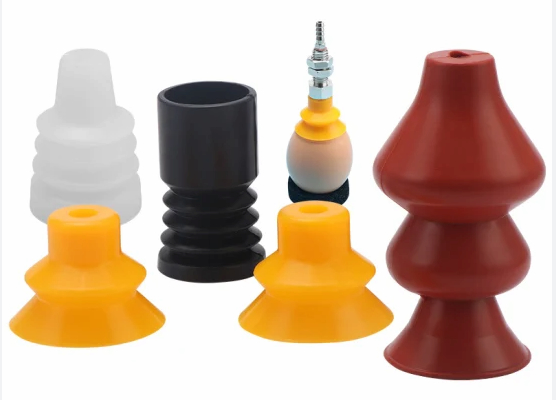
A suction cup is a flexible sealing component designed to create a pressure difference between the inside of the cup and the surrounding environment. Depending on the design, the cup may be used for manual holding, hanging, fixing or automated lifting and gripping.
Industrial vacuum cups normally form part of a larger vacuum handling system. The cup is connected to a vacuum source and mounting hardware, allowing the system to pick, transfer or hold a workpiece.
Industrial manufacturers offer different designs including flat cups, bellows cups, oval cups, multi-bellows cups, deep cups and application-specific vacuum cups. Schmalz, for example, lists flat, oval, bellows and bell-shaped suction cup categories and offers different elastomer materials for different applications.
Suction Cup vs. Vacuum Cup: Are They the Same?
The terminology can be confusing.
A conventional suction cup generally creates a seal through physical pressure against a surface. An industrial vacuum cup is normally connected to a vacuum generator or pump that actively removes air from the cup.
DESTACO specifically distinguishes between the two concepts. Its technical guidance explains that vacuum cups use a pneumatic vacuum generator to create the pressure differential required for lifting, while a conventional suction cup creates its seal through downward pressure and expelled air.
For industrial sourcing, therefore, buyers should specify whether they need:
- Manual suction cups
- Industrial vacuum cups
- Robotic end-of-arm tooling cups
- Vacuum pads
- Silicone suction cups
- Rubber suction cups
- Food-grade suction cups
- High-temperature vacuum cups
- ESD or conductive suction cups
- Custom-molded silicone vacuum pads
How to Choose Suction Cup Manufacturers

The cheapest suction cup is not necessarily the most economical solution. A cup that leaks, deforms, leaves marks or fails during high-cycle operation can create much greater costs through downtime and rejected products.
1. Identify the Workpiece Surface
The surface is one of the most important selection factors. Flat glass, sheet metal, cardboard, plastic film, wood, porous packaging and irregular components require different sealing approaches.
For example, Schmalz provides specific suction cup solutions for plastic films, paper, glass, wood, composites, sheet metal and electronics.
2. Select the Correct Cup Geometry
Common designs include:
- Flat suction cups for relatively flat surfaces
- Bellows suction cups for uneven or curved surfaces
- Oval cups for narrow or elongated products
- Multi-bellows cups for height differences
- Deep cups for specific gripping applications
- Specialized cups for porous, textured or delicate materials
Piab's current product portfolio illustrates the breadth of this category, including flat, concave, bellows, multi-bellows, deep and modular suction cups.
3. Check Material and Hardness
Material selection affects sealing performance, wear resistance, temperature resistance, chemical resistance and surface marking.
Common materials include silicone, NBR, EPDM, polyurethane, natural rubber, HNBR, TPE and specialized elastomers.
Schmalz offers suction cups in materials including NBR, silicone, EPDM and specialized materials such as HT1 and HT1-ESD.
COVAL's C Series, for example, uses NBR and SITON materials for industrial applications and specifies different temperature and abrasion characteristics for these materials.
4. Consider Vacuum Level and Holding Force
The holding force depends on several factors rather than simply the diameter of the cup. Buyers should consider effective sealing area, vacuum level, surface quality, friction, acceleration, load orientation and safety factors.
For robotic applications, the engineering team should calculate the required gripping force rather than selecting a cup based solely on catalog dimensions.
5. Verify Mounting and Connection
Even a technically suitable vacuum cup cannot be used efficiently if the connection does not match the robot, vacuum generator or end-of-arm tooling system.
Check:
- Thread type
- Metric or imperial connection
- Male or female fitting
- Quick-change connection
- Level compensation
- Spring compensation
- Mounting height
- Vacuum hose connection
7 Suction Cup Manufacturers and Suppliers to Consider
1. ANVER – Industrial Vacuum Cups and Suction Cup Manufacturer
Company: ANVER Corporation
Official website: [ANVER](https://anver.com/
Address: 36 Parmenter Rd, Hudson, MA 01749-3214, USA
Hotline: +1 978-568-0221
Email: info@anver.com
Certification: ISO 9001:2015
ANVER is one of the most directly relevant companies for buyers searching for industrial suction cup manufacturers and vacuum cup manufacturers. The company specializes in vacuum material handling and supplies vacuum cups, vacuum lifters, vacuum generators, vacuum components and related equipment.
ANVER's own website states that it is a producer rather than simply a reseller, with a broad inventory of suction cups, vacuum cups, level compensators, suspensions, mountings and sealing rings. Its product selection includes flat vacuum cups and bellows-style cups designed for different workpiece geometries.
ANVER also provides a dealer locator, which is particularly relevant to buyers searching for anver suction cup distributors. However, buyers should distinguish between ANVER's own manufacturing/supply operation and independent distributors or dealers serving particular territories.
Detailed review: ANVER is particularly strong for industrial vacuum handling rather than simple consumer suction cups. Buyers can evaluate complete vacuum lifting solutions as well as replacement cups and components. This makes the company relevant to manufacturers that need both the elastomer cup and the broader vacuum-handling infrastructure.
The company is also useful when application engineering is important. Instead of choosing a generic cup solely on diameter, buyers can discuss the workpiece, lifting orientation, load and vacuum system requirements.
Best suited for: industrial material handling, vacuum lifting, sheet materials, glass, automation systems, OEMs and industrial distributors.
Buyer note: Request the exact cup model, material, diameter, connection, recommended vacuum range and intended application before ordering replacement components.
2. Adams Manufacturing – High-Volume Suction Cup Manufacturer
Company: Adams Manufacturing Corp.
Official website: [Adams Manufacturing](https://www.adamsmfg.com/contact
Suction cup store: [Adams Suction Cup eStore](https://suctioncups.com/
Address: 109 West Park Road, Portersville, PA 16051-2209, USA
Hotline: +1 800-237-8287
Adams Manufacturing is particularly important for buyers searching for Adams Manufacturing suction cups. The company says it began in 1976 by selling suction cups and has since expanded into injection-molded consumer products, furniture and accessories.
Adams states that its suction cup line is 100% made in the USA using domestic material. The company also describes itself as a major supplier of suction cups to North American mass merchants and hardware retailers.
The dedicated suction cup eStore offers cups by size, type and application, including cups with hooks, mushroom heads and different pilot-hole configurations. Bulk packaging is available for commercial buyers.
Detailed review: Adams is especially interesting for buyers that need standardized suction cups in commercial quantities rather than a highly engineered robotic gripping solution. Its dedicated suction cup catalog and bulk ordering structure make the company relevant to hardware, retail, display, hanging and fixing applications.
Another advantage is that buyers can source directly through the dedicated suction cup sales channel. Adams states that there is no minimum order amount for suction cups, although each SKU still has its own minimum bag or box quantity.
Best suited for: wholesale buyers, hardware distributors, retail programs, display applications, hanging systems and commercial bulk purchases.
Buyer note: If the application requires robotic vacuum gripping, buyers should verify whether the Adams product is appropriate rather than assuming that a general-purpose suction cup is equivalent to an industrial vacuum cup.
3. J. Schmalz GmbH – Advanced Vacuum Cup Manufacturer
Company: J. Schmalz GmbH
Official website: [Schmalz](https://www.schmalz.com/en/support/contact-center
Headquarters: Johannes-Schmalz-Str. 1, 72293 Glatten, Germany
Hotline: +49 7443 2403-102
Email: customercenter@schmalz.de
Schmalz is one of the most comprehensive companies in the vacuum automation sector. Its product portfolio includes vacuum suction cups, vacuum generators, gripping systems, manual handling equipment, vacuum clamping systems and automation technologies.
The company's suction cup range includes flat round cups, flat oval cups, round and oval bellows cups, bell-shaped cups and specialized products for industries such as electronics, packaging, sheet metal, glass, wood and plastics.
Schmalz also offers application-specific materials. Its current catalog includes silicone, NBR, EPDM, HT1, ESD-compatible materials and other specialized elastomers. Some products are designed to minimize marking on sensitive components, while others target high-temperature or demanding industrial applications.
Detailed review: Schmalz is particularly strong for engineering-intensive applications where the suction cup is part of a complete automation solution. Buyers can select cups according to geometry, material, connection, surface type and industry.
For electronics, packaging or delicate workpieces, the availability of specialized materials can be an important advantage. For heavy industrial handling, the company also offers application-specific cups designed for sheet metal, wood and other challenging materials.
Best suited for: robotic automation, packaging, electronics, automotive, glass, sheet metal, woodworking and advanced industrial handling.
Buyer note: Schmalz should be evaluated based on the complete application, not only the individual cup price. Compatibility with the vacuum generator, mounting system and robot end effector can have a significant effect on total system performance.
4. Piab – Vacuum Cup and Robotic Gripping Specialist
Company: Piab AB
Official website: [Piab](https://www.piab.com/en-us/suction-cups-and-soft-grippers
Headquarters: Danderyd, Sweden
Phone: +46 8 630 25 00
Email: info-sweden@piab.com
Piab is a Swedish vacuum technology company with a long history in vacuum automation. The company states that its vacuum division was established in the 1960s and that vacuum pumps, suction cups and vacuum conveyors subsequently became important parts of its product portfolio. Piab now operates internationally with sales offices and partners around the world.
Piab's current suction cup portfolio is extensive. It includes round suction cups, oval cups, rectangular cups, flat cups, bellows cups, multi-bellows cups, deep cups and modular suction cup systems.
The company also organizes suction cups according to application, including non-marking handling, cardboard, bags, high and low temperatures, food contact, ESD protection, electronics, thin films and heavy lifting.
One notable feature is the PiGRIP modular concept. Buyers can configure different lips, bellows, supports and fittings to create a suction cup adapted to the application.
Detailed review: Piab is particularly suitable for automation integrators and manufacturers that need more than a generic vacuum cup. Its broad catalog makes it possible to select specialized solutions for packaging, automotive, electronics, food processing, logistics and robotic pick-and-place systems.
The company's range also includes silicone cups for food and packaging applications, conductive silicone products for electronics and specialized cups for high-temperature or difficult surfaces.
Best suited for: robotic gripping, packaging automation, logistics, food processing, automotive, electronics and industrial automation.
Buyer note: Piab's configurable products are especially useful when a standard cup does not provide sufficient flexibility or surface adaptation.
5. DESTACO – Vacuum Cups for Robotic Automation
Company: DESTACO
Official website: [DESTACO](https://www.destaco.com/
Corporate headquarters: 15 Corporate Drive, Auburn Hills, MI 48326, USA
Hotline: +1 888-337-8226 / +1 248-836-6700
DESTACO is an industrial automation and workholding company that offers vacuum cups as part of its robotic tooling and end-of-arm tooling portfolio.
The company's vacuum cup range includes multiple shapes, sizes and materials. DESTACO lists nitrile rubber, silicone, Viton and high-temperature materials among its vacuum cup options.
DESTACO also provides technical guidance for selecting vacuum cups. Its selection methodology considers cup hardness, surface contour, oily or dry surfaces, tread pattern, mounting type and automation requirements.
Detailed review: DESTACO is a strong option when the suction cup is part of a broader robotic tooling system. The company's engineering approach is useful for manufacturers handling sheet metal, automotive components and industrial parts where acceleration, deceleration and repeatability matter.
The company explains that softer cups can be useful for contoured surfaces while harder cups may be better suited to certain flat or oily surfaces. This highlights why buyers should not select cups solely by outside diameter.
Best suited for: robotic tooling, automotive manufacturing, stamping, sheet-metal handling, industrial automation and pick-and-place systems.
Buyer note: Check the connection type and cup hardness against the existing end-of-arm tooling before changing brands.
6. COVAL – French Vacuum Cup and Gripping Technology Manufacturer
Company: COVAL
Official website: https://www.coval.com/
Head office: ZA des Petits Champs, 10 allée Jean-Baptiste Venturi, 26120 Montélier, France
Phone: +33 4 75 59 91 91
Email: contact@coval.com
COVAL is a French vacuum technology company serving industrial automation markets. Its portfolio includes vacuum cups, vacuum generators, vacuum switches and complete gripping solutions. The company specifically states that its products are aimed at professional industrial sectors including packaging, plastics, automotive, graphic industries and aerospace.
COVAL's C Series is a useful example of an industrial suction cup range designed for demanding applications. The series includes flat cups, oblong flat cups, 1.5-bellows cups and oblong bellows cups, with multiple fitting options.
The C Series uses NBR and SITON materials, with product specifications addressing oil resistance, temperature resistance and abrasion resistance. The range is also designed for automated applications such as stamping and welding.
Detailed review: COVAL is particularly relevant to automation buyers that need specialized vacuum gripping for manufacturing processes. Its products are more appropriate for industrial engineering than simple consumer suction applications.
The company also maintains an international distributor network, which can be important for buyers who need local technical or commercial support. COVAL provides sales contacts for France, Italy, Spain, the United States and international markets.
Best suited for: automotive, packaging, plastics, sheet-metal automation, aerospace-related manufacturing and industrial robotics.
Buyer note: For high-cycle automation, evaluate the cup material, sealing lip, fitting, acceleration and surface condition together.
7. MINH FAST – Custom Silicone Suction Cup and Vacuum Pad Manufacturer in Vietnam
Company: MINH FAST Company Limited
Official website: https://vietnamsiliconerubber.com
Head office: No. 1/19 Luong Khanh Thien Street, Tuong Mai Ward, Hanoi, Vietnam
Factory: Km 33 – DT 379, Van Giang, Hung Yen, Vietnam
Phone / Zalo / WhatsApp: +84 8899 14599
Email: Minhfastsales@gmail.com
MINH FAST represents a different category from the industrial vacuum automation brands above. It is a Vietnam-based custom silicone and rubber manufacturer focused on OEM/ODM production rather than a conventional catalog-based vacuum automation company.
The company was established in 2010 and states that its capabilities include custom silicone molding, industrial rubber products, precision silicone molds, LSR injection molding and other custom manufacturing services.
MINH FAST also publishes a dedicated manufacturing application for silicone vacuum pads, silicone suction pads and silicone vacuum suction cups. The company positions these products for automation, robotics, food processing, medical production and industrial applications where custom silicone components may be required.
Detailed review: MINH FAST is most relevant when a buyer does not simply want to purchase an existing standard cup. Instead, the company can be evaluated when the project requires a custom silicone geometry, specific hardness, custom mold, particular dimensions, private-label production or OEM development.
This distinction is important. A company sourcing a replacement Schmalz or Piab cup may need an established vacuum automation supplier. A company developing a proprietary vacuum pad or silicone suction component may instead need a manufacturer capable of creating tooling and producing the custom elastomer part.
MINH FAST states that it supports customers with completed product designs, CAD drawings or technical specifications and can provide manufacturing for prototypes, small batches and larger production volumes.
Best suited for: OEM/ODM projects, custom silicone suction pads, custom vacuum cups, automation components, private-label products and companies seeking Vietnam-based manufacturing.
Buyer note: For an industrial vacuum application, the buyer should provide technical requirements such as vacuum level, workpiece material, cup diameter, hardness, temperature range, connection design and expected cycle life.
Suction Cup Manufacturers Comparison
| Company | Country | Main Strength | Typical Buyer |
|---|---|---|---|
| ANVER | USA | Vacuum cups and material handling | Industrial users, distributors and OEMs |
| Adams Manufacturing | USA | Bulk suction cups and molded products | Wholesale, hardware and retail buyers |
| Schmalz | Germany | Advanced vacuum automation | Robotics and industrial automation |
| Piab | Sweden | Vacuum cups and robotic gripping | Automation integrators and manufacturers |
| DESTACO | USA | Robotic tooling and vacuum cups | Automotive and industrial automation |
| COVAL | France | Industrial vacuum gripping | Automation and manufacturing |
| MINH FAST | Vietnam | Custom silicone and rubber OEM | Private-label and custom-product developers |
How to Choose Between Standard Suction Cups and Custom Manufacturing
The choice between an established vacuum cup supplier and a custom manufacturer depends on the project.
Choose a Standard Supplier When:
- You need replacement cups for an existing vacuum system.
- The machine already has a defined mounting interface.
- You need immediate or relatively fast availability.
- The required cup is already available as a standard catalog product.
- You need application engineering from a vacuum automation specialist.
Consider Custom OEM Manufacturing When:
- The required cup does not exist in standard catalogs.
- You need a proprietary shape.
- You need custom silicone hardness.
- You require a special sealing lip.
- You need a custom mold.
- You want your own brand or packaging.
- You need a large production run.
- You want to redesign the component to reduce manufacturing cost.
What Should Be Included in a Suction Cup RFQ?
When requesting quotations from suction cup suppliers, provide enough technical information for suppliers to quote the same specification.
- Product drawing or CAD file
- Outer diameter
- Overall height
- Sealing lip dimensions
- Number of bellows
- Material specification
- Shore hardness
- Vacuum operating range
- Working temperature
- Surface condition of the workpiece
- Workpiece weight
- Horizontal or vertical lifting
- Acceleration and deceleration
- Cycle frequency
- Required fitting or thread
- Expected service life
- Required quantity per order
- Annual estimated volume
- Packaging requirements
- Testing and certification requirements
Material Selection for Vacuum Cups
Silicone
Silicone is useful where flexibility, temperature resistance or specialized food-contact requirements are important. Silicone suction cups can also be produced in custom shapes through molding.
Piab, for example, offers silicone suction cups for packaging and food applications, including FDA/EU-approved options.
NBR
NBR is commonly used where oil resistance and general industrial performance are important. COVAL's C Series includes NBR suction cups designed for industrial applications and resistance to oily sheet-metal environments.
EPDM
EPDM is used in applications requiring specific resistance characteristics and is available in vacuum cup product families from companies such as Schmalz and Piab.
Polyurethane and TPE
Polyurethane and TPE can be useful where wear resistance, flexibility, recyclability or special gripping characteristics are required. Piab, for example, offers polyurethane and recyclable TPE suction cup products for different applications.
Suction Cup Applications
Suction cups and vacuum cups are used across many industries, including:
- Robotic pick-and-place systems
- Packaging machinery
- Carton handling
- Glass handling
- Sheet-metal transfer
- Automotive production
- Electronics assembly
- Battery manufacturing
- Plastic component handling
- Woodworking
- Food processing
- Logistics automation
- Printing and paper handling
- Industrial material handling
Modern vacuum cup portfolios increasingly address specialized applications. Schmalz lists solutions for electronics, glass, wood, composites, packaging and high-temperature applications, while Piab organizes products around packaging, food contact, electronics, cardboard, bags and heavy lifting.
Questions to Ask Suction Cup Suppliers
Before purchasing, buyers should ask suppliers:
- What material is the suction cup made from?
- What is the Shore hardness?
- What vacuum range is recommended?
- What is the maximum safe load?
- What surface types are supported?
- Is the cup suitable for oily surfaces?
- Is it suitable for porous materials?
- Will it leave marks on the product?
- What temperature range can it withstand?
- What is the expected cycle life?
- Which fittings are available?
- Can the cup be supplied with a level compensator?
- Are replacement parts available?
- Is technical application support available?
- Can samples be tested before mass purchase?
- Is the product available through distributors?
- Can the supplier manufacture a custom version?
How to Compare Suction Cup Manufacturers
Price should not be the only comparison factor. A better purchasing model is to evaluate the total cost of ownership.
| Evaluation Factor | Why It Matters |
|---|---|
| Unit price | Determines initial purchasing cost |
| Service life | Affects replacement frequency |
| Vacuum performance | Influences gripping reliability |
| Material | Affects temperature, chemical and wear resistance |
| Surface compatibility | Determines sealing performance |
| Mounting compatibility | Prevents installation problems |
| Availability | Important for production continuity |
| Technical support | Useful for automation applications |
| Customization | Important for proprietary products |
| MOQ | Affects inventory and working capital |
ANVER Suction Cup Distributors: What Buyers Should Know
Buyers specifically searching for anver suction cup distributors should first identify whether they need direct purchasing from ANVER or local distributor support.
ANVER maintains a dealer locator and supplies vacuum cups, vacuum components and material-handling products directly. The company's website also identifies ANVER as the producer of its vacuum cup products.
For international buyers, a distributor may provide advantages such as local stock, local currency, shorter delivery times and technical assistance. However, buyers should verify that the distributor is authorized and that the supplied part number is identical to the required ANVER product.
Adams Manufacturing Suction Cups for Wholesale Buyers
Adams Manufacturing is particularly relevant for businesses searching for Adams Manufacturing suction cups in bulk. The company operates a dedicated suction cup eStore and offers cups in different sizes, types and configurations.
Adams states that its suction cup line is 100% made in the USA using domestic material. It also provides bulk packaging and allows buyers to order suction cups directly through its dedicated channel.
This makes Adams particularly interesting for distributors, hardware suppliers, display-product manufacturers and businesses that need standardized suction cups rather than fully customized industrial vacuum tooling.
Custom Silicone Suction Cups from Vietnam
Companies developing their own suction cup products may want to consider a custom silicone manufacturer rather than relying entirely on standard catalog products.
MINH FAST is a Vietnam-based silicone and rubber manufacturer that provides custom molding and OEM/ODM manufacturing. Its published capabilities include silicone molding, LSR injection molding, precision mold manufacturing and custom rubber products.
The company also specifically presents silicone vacuum pad and silicone vacuum suction cup manufacturing for industrial applications. This can be relevant to buyers who need a custom geometry, specific silicone hardness, proprietary mold or private-label production.
For an OEM project, buyers should provide a CAD drawing, sample or technical specification and ask for tooling cost, prototype cost, MOQ, production capacity, material documentation and testing requirements.
Final Checklist Before Selecting Suction Cup Manufacturers
- Confirm whether you need a suction cup or industrial vacuum cup.
- Identify the workpiece material and surface condition.
- Select the appropriate cup geometry.
- Confirm material and Shore hardness.
- Calculate required holding force.
- Check vacuum level and leakage requirements.
- Confirm fitting and mounting compatibility.
- Evaluate operating temperature.
- Check resistance to oil, chemicals or abrasion.
- Consider cycle frequency and expected service life.
- Request technical data sheets.
- Test samples before large-volume purchasing.
- Compare total cost rather than unit price alone.
- Verify distributor status where applicable.
- For custom products, confirm tooling ownership and mold costs.
Conclusion
The suction cup market covers a wide range of products, from simple consumer suction cups to highly engineered vacuum cups used in robotics and industrial automation. As a result, the right supplier depends heavily on the application.
ANVER is particularly relevant for vacuum material handling and industrial suction cups. Adams Manufacturing is a strong option for bulk standardized suction cups and wholesale applications. Schmalz and Piab provide extensive vacuum automation portfolios for demanding industrial applications. DESTACO is relevant to robotic tooling and automation, while COVAL focuses on industrial vacuum gripping technology.
MINH FAST represents a different sourcing model. As a Vietnam-based silicone and rubber OEM manufacturer, it is more appropriate when a buyer needs a custom silicone suction pad, vacuum cup or molded component rather than an off-the-shelf replacement part.
For procurement teams, the best approach is to define the application first and then compare manufacturers according to material, cup geometry, vacuum performance, mounting system, durability, availability, technical support and total cost of ownership.
Rather than choosing a supplier solely because it has the lowest price, buyers should select the manufacturer whose suction cup design and manufacturing capabilities match the actual surface, load, cycle rate and operating environment.
main.comment_read_more